|
|
|
 |
|
|
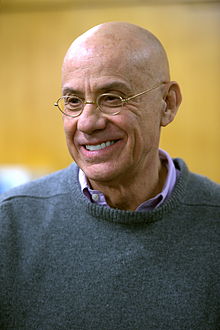
VJ Books presents James Ellroy! James Ellroy was born in 1948 in Los Angeles, California. After his parents' divorce, Ellroy and his mother, Geneva Hilliker, relocated to El Monte, California. In 1958, Ellroy's mother was murdered. The police never arrested the perpetrator, and the case remains unsolved. The murder, along with The Badge by Jack Webb (a book composed of sensational cases from the files of the Los Angeles Police Department, a birthday gift from his father), were important events of Ellroy's youth.
Ellroy dropped out of school without graduating. During his teens and twenties, he drank heavily, engaged in minor crimes (especially shoplifting, house-breaking and burglary), and was often homeless. After serving some time in jail and suffering a bout of pneumonia, Ellroy stopped drinking and began working as a golf caddy while pursuing writing. He later said, "Caddying was good tax-free cash and allowed me to get home by 2 p.m. and write books... I caddied right up to the sale of my fifth book."
In 1981, Ellroy published his first novel, Brown's Requiem, a detective story drawing on his experiences as a caddy. He then published Clandestine and Silent Terror (which was later published under the title Killer on the Road). Ellroy followed these three novels with the Lloyd Hopkins Trilogy, three novels following the eponymous character.
While his early novels earned him a "cult" following, Ellroy earned much greater success and critical acclaim with the L.A. Quartet—The Black Dahlia, The Big Nowhere, L.A. Confidential, and White Jazz. The four novels represent Ellroy's change of style from the tradition of classic modernist noir fiction of his earlier novels to so-called postmodern historiographic metafiction. The Black Dahlia, for example, fused the real-life murder of Elizabeth Short with a fictional story of two police officers investigating the crime.
In 1995, Ellroy published American Tabloid, the first novel in a series informally dubbed the "American Underworld Trilogy", which Ellroy describes as a "secret history" of the mid-to-late twentieth century. Tabloid was named TIME's fiction book of year for 1995. Its follow-up, The Cold Six Thousand, became a bestseller. The final novel, Blood's a Rover, will be released in September 2009.
After publishing American Tabloid, Ellroy began a memoir, My Dark Places based on his memories of his mother's murder and his investigation of the crime. Frank C. Girardot, a reporter for The San Gabriel Valley Tribune, accessed files on Geneva Hilliker Ellroy's murder from detectives with Los Angeles Police Department. Based on the cold case file, Ellroy and investigator Bill Stoner worked the case, but gave up after fifteen months, believing any suspects to be dead
In 2006, after his divorce with Helen Knode, Ellroy returned to Los Angeles. He is a self-described hermit who possesses very few technological amenities, including television, and never reads other people's work, aside from Joseph Wambaugh's The Onion Field, for which he wrote the introduction. Ellroy writes longhand on legal pads, rather than on a computer, and
prepares elaborate outlines for his books, most of which are several
hundred pages long.
In media appearances, Ellroy has adopted an outsized, stylized public persona of hard-boiled nihilism and self-reflexive subversiveness. Another aspect of his public persona involves an almost comically grand assessment of his work and his place in literature. For example, he told the New York Times, "I am a master of fiction. I am also the greatest crime novelist who ever lived. I am to the crime novel in specific what Tolstoy is to the Russian novel and what Beethoven is to music."
Dialog and narration in Ellroy novels often consists of a "heightened pastiche of jazz slang, cop patois, creative profanity and drug vernacular," with a particular use of period-appropriate, but now anachronistic, slang. He often employs stripped-down staccato sentence structures, a style that reaches its apex in The Cold Six Thousand, and which Ellroy describes as a "direct, shorter-rather-than-longer sentence style that's declarative and ugly and right there, punching you in the nards." While each sentence on its own is simple, the cumulative effect is a dense, baroque style.Other hallmarks of his work include dense
plotting and a relentlessly pessimistic—albeit moral—worldview. His
work has earned Ellroy the nickname the "Demon Dog of American crime
fiction."
Structurally, several of Ellroy's books, such as The Big Nowhere, L.A. Confidential, American Tabloid, and The Cold Six Thousand, have three disparate points of view through different characters, with chapters alternating between them. Starting with The Black Dahlia, Ellroy's novels have mostly been historical dramas about the relationship between corruption and law enforcement.
Ellroy lives in Los Angeles, California.
|
|
|
|